Against The Gods: The Remarkable Story of Risk
Peter L. Bernstein
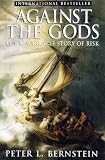

This book is a classic worldwide bestseller that covers really in depth on the topic of risk measurement and management. From the title "Story of Risk", it can be translated to "history of statistics" dating back from 1200s to modern times. Names suchs as Keynes, Pascal, the Bernoullis, Laplace, Galton etc are mentioned in great detail as they contributed much to what we have now (such as the bell curve).
As a matter of fact, I do not really understand the earlier chapters as the subject matter and the depth of it tend to bore me out. But I have to admit that if the interest is there, it would be a tremendous read. However, as it approaches the last third of the book, topics covered becomes more relevant to what I have learnt, therefore understanding became easier.
John von Neumann is a name that facinated me. According to the author, he is the inventor of game theory and many other fields from economics to quantum mechanics. He also contributed to the utility theory (where satisfaction is measured, isn't it amusing). If you don't think that is facinating, then you probably won't be surprised that risk can also be measured. Harry Markowitz taught us that risk can be measured by something he called "variance", derived from a normal distribution. Until today this concept is still debated and I still do not understand how a value of variance tell me if I should make a gamble.
Financial engineering is not too old but has its roots in the aboved mentioned names as well. In the past people take on certain risk and win (or lose) to the house. Today, it is possible for risk to be traded through derivatives, first invented by some brillant mathe- maticians called Fisher Black, Myron Scholes and Robert Merton. Risk now has a monetary value attached. The market for options exploded not long after their paper on option pricing saw light in the world with the Chicago Board Options Exchange (CBOE) performing this function for bankers, institutions and commoners alike.
Just like what we saw in the subprime crisis, where some banks created stupid risks and won, and AIG became the ultimate loser.
This is definitely a must read for deeply interested in mathe- matics, statistics and risk. Will revisit this book again in the near future for a better understanding.
As a matter of fact, I do not really understand the earlier chapters as the subject matter and the depth of it tend to bore me out. But I have to admit that if the interest is there, it would be a tremendous read. However, as it approaches the last third of the book, topics covered becomes more relevant to what I have learnt, therefore understanding became easier.
John von Neumann is a name that facinated me. According to the author, he is the inventor of game theory and many other fields from economics to quantum mechanics. He also contributed to the utility theory (where satisfaction is measured, isn't it amusing). If you don't think that is facinating, then you probably won't be surprised that risk can also be measured. Harry Markowitz taught us that risk can be measured by something he called "variance", derived from a normal distribution. Until today this concept is still debated and I still do not understand how a value of variance tell me if I should make a gamble.
Financial engineering is not too old but has its roots in the aboved mentioned names as well. In the past people take on certain risk and win (or lose) to the house. Today, it is possible for risk to be traded through derivatives, first invented by some brillant mathe- maticians called Fisher Black, Myron Scholes and Robert Merton. Risk now has a monetary value attached. The market for options exploded not long after their paper on option pricing saw light in the world with the Chicago Board Options Exchange (CBOE) performing this function for bankers, institutions and commoners alike.
Just like what we saw in the subprime crisis, where some banks created stupid risks and won, and AIG became the ultimate loser.
This is definitely a must read for deeply interested in mathe- matics, statistics and risk. Will revisit this book again in the near future for a better understanding.


No comments:
Post a Comment